Why Dog Size Is the #1 Factor in Choosing a Pet Stroller
Pick the wrong size pet stroller and your dog won't use it — too cramped, too unstable, or simply too uncomfortable. Yet many buyers focus on color, price, or folding mechanism first, only to realize the stroller doesn't actually fit their dog.
Choosing the right pet stroller starts with two numbers: your dog's weight and your dog's body length (nose to tail base). Weight determines whether the frame and wheels can handle the load safely. Body length determines whether the cabin is deep enough for your dog to sit and lie down comfortably. Both matter — a 12 kg Dachshund has a completely different body shape than a 12 kg French Bulldog.
This guide breaks down pet stroller sizing by weight class — from Chihuahuas to Golden Retrievers — with clear specs, breed examples, and what to look for in each tier. Whether you're a pet owner buying one stroller or a business owner buying a hundred, the sizing logic is the same.
Small Dogs (<10 kg): Lightweight & Compact
Common Breeds
Chihuahua, Yorkshire Terrier, Pomeranian, Toy Poodle, Shih Tzu, Maltese, Miniature Dachshund, and cats. This is the largest segment by sales volume — small dogs and cats account for roughly 60% of pet stroller purchases.
What to Look For
- Stroller weight under 6 kg: You'll be lifting it in and out of car trunks, up stairs, and through doorways. Every extra kilogram matters.
- Compact one-hand fold: A stroller that folds flat or stands upright when collapsed saves serious storage space in apartments and small cars.
- Good canopy visibility: Mesh windows on the top and sides so your pet can see out and you can check on them without stopping.
- Safety tether inside: A clip that attaches to your dog's harness prevents jumping out when the canopy is unzipped.
- Color and style options: Small-dog owners tend to care about aesthetics — this is the most design-driven segment.
Recommended Specs
| Specification | What to Look For |
|---|---|
| Weight capacity | 15 kg minimum — gives one small dog comfortable room |
| Stroller weight | 4.5–6 kg — easy to carry and lift |
| Cabin size | L 45–55 cm x W 28–32 cm x H 45–50 cm |
| Fold type | One-hand or one-click compact fold |
| Wheels | 4-wheel, front swivel with lock, EVA or PU |
Recommended specifications for small-dog pet strollers
Top Pick for Small Dogs
The 4.45 kg ultra-lightweight model is the lightest full-featured stroller on the market — compact enough for daily city use, with a one-hand fold and a roomy cabin for dogs up to 15 kg. For those who want a slightly larger basket and premium Oxford fabric, the foldable 4-wheel model is a solid step up.
Medium Dogs (10–25 kg): The Most Popular Category
Common Breeds
French Bulldog, Corgi, Beagle, Boston Terrier, Pug, Shiba Inu, Cavalier King Charles Spaniel, and medium mixed breeds. This is the most competitive size category — medium dogs make up a huge portion of pet ownership, and many breeds in this group have health conditions that make strollers particularly useful.
What to Look For
- Carbon steel frame: Medium dogs move, shift, and reposition more than small dogs. The frame needs to stay stable without wobbling.
- Large mesh ventilation: Brachycephalic breeds (Frenchies, Pugs, Boston Terriers) overheat quickly. Multiple large mesh panels are non-negotiable for safe use in warm weather.
- Removable, washable padding: Medium dogs shed. Being able to unzip the interior pad and throw it in the washing machine saves a lot of frustration.
- Large under-basket: You'll carry water bottles, treats, a leash, and maybe some shopping. A decent-sized storage basket matters more than most people expect.
- Dual rear brakes: At 15–25 kg of moving weight, single-brake strollers can creep on slopes. Dual brakes that lock firmly are a safety requirement, not a nice-to-have.
Recommended Specs
| Specification | What to Look For |
|---|---|
| Weight capacity | 25–30 kg — gives one medium dog comfort plus margin |
| Stroller weight | 7–10 kg — sturdy but still car-liftable |
| Cabin size | L 55–65 cm x W 33–38 cm x H 50–58 cm |
| Frame material | Carbon steel, 1.0–1.2 mm tube thickness |
| Wheels | 4-wheel, 6"–7" EVA, front swivel with lock |
Recommended specifications for medium-dog pet strollers
Top Pick for Medium Dogs
The standard foldable model (25 kg capacity) is the best all-rounder in this category — carbon steel frame, 600D Oxford fabric, large mesh canopy, and a 7.5 kg body weight that's still manageable for daily use. If your medium dog travels by car often, the detachable 2-in-1 model has a carrier cabin that clicks out and doubles as a car seat — no need to lift your dog out and in at every stop.
Large Dogs (>25 kg): Heavy-Duty & All-Terrain
Common Breeds
Golden Retriever, Labrador, German Shepherd, Husky, Border Collie, Boxer, and large mixed breeds. Large-dog strollers serve specific use cases: senior dogs with arthritis or hip dysplasia, post-surgery recovery, injured dogs, or multi-dog households that use the stroller for one dog while walking another.
What to Look For
- Reinforced steel frame (1.2 mm+): At 30+ kg of moving weight, frame flex isn't just uncomfortable — it's unsafe. The frame must stay rigid under load.
- All-terrain wheels (8"+): Large-dog walks go off pavement. Grass, gravel, uneven sidewalks, park trails — the wheels need tread and diameter to handle varied surfaces without getting stuck.
- Heavy-duty dual brakes: Stopping 40–50 kg on a slope requires serious braking force. Test this specifically — push the loaded stroller on a slight incline and lock the brakes. It should not budge.
- Low rear entry point: A senior dog with hip pain can't step over a high cabin wall. Look for a rear opening that sits low to the ground, or a fold-down ramp.
- Multi-panel ventilation: Large dogs generate significant body heat inside an enclosed cabin. Mesh on at least three sides keeps air moving.
Recommended Specs
| Specification | What to Look For |
|---|---|
| Weight capacity | 50–80 kg — fits one large dog or two medium dogs |
| Stroller weight | 12–16 kg — heavy, but needed for structural strength |
| Cabin size | L 70–85 cm x W 42–55 cm x H 58–65 cm |
| Frame material | Carbon steel, reinforced joints, 1.2–1.5 mm tubing |
| Wheels | 4-wheel, 8"–10" EVA or PU, all-terrain tread |
Recommended specifications for large-dog pet strollers
Top Pick for Large Dogs
The heavy-duty 80 kg model is built specifically for large breeds — reinforced steel frame, 10" all-terrain PU wheels, dual rear brakes, and a cabin spacious enough for a full-grown Golden Retriever to sit and turn around. For multi-pet homes, the wagon-style stroller fits two medium dogs side by side with 50 kg combined capacity.
Multi-Pet Strollers: One Stroller, Two (or More) Passengers
Who Needs One
Households with 2+ small or medium dogs, a dog and a cat, or a parent with two small dogs that share walks. Multi-pet households are growing fast — over 60% of US pet owners now have more than one pet. A dual-purpose stroller saves money and storage space vs buying two separate units.
Key Features to Check
- Wide side-by-side cabin or tandem layout: Side-by-side (wagon style) lets both pets look out; front-and-back saves width in narrow doorways. A removable divider is a nice extra.
- Combined weight capacity of 30–50 kg: Check the total, not per-pet, rating — two 10 kg dogs need a 25+ kg capacity for comfort.
- Two separate safety tethers: Each pet needs its own clip. Sharing one risks tangling and one pet getting dragged if the other jumps.
- Wide, stable wheelbase: When two pets shift weight at the same time, a narrow stroller can tip. Look for an axle width of at least 55 cm.
The Myeece wagon stroller is designed for multi-pet use — dual entry points (front and rear), a flat, wide cabin floor with non-slip lining, and separate tether clips for two pets.
Quick Size Comparison: At a Glance
| Size Tier | Weight Capacity | Example Breeds | Stroller Weight |
|---|---|---|---|
| Small (<10 kg) | 15 kg | Chihuahua, Yorkie, Pomeranian, Toy Poodle, cat | 4.5–6 kg |
| Medium (10–25 kg) | 25–30 kg | French Bulldog, Corgi, Beagle, Pug, Shiba Inu | 7–10 kg |
| Large (>25 kg) | 50–80 kg | Golden Retriever, Labrador, German Shepherd, Husky | 12–16 kg |
| Multi-Pet | 30–50 kg (combined) | Two small/medium dogs, dog + cat | 11–15 kg |
Quick-reference comparison across all four pet stroller size categories
3 Common Sizing Mistakes
Mistake 1: Only Checking the Weight Rating
A stroller rated for 25 kg might technically hold your 22 kg Beagle, but if the cabin is too short (less than 55 cm long), your dog will be hunched up every ride. Always check both weight capacity and interior cabin dimensions — length, width, and height. Your dog should be able to sit upright, turn around, and lie down without pressing against any wall. Measure your dog's standing height (floor to top of head) and lying length (nose to tail base) before shopping.
Mistake 2: Buying Too Small to Save Weight
It's tempting to choose the lightest stroller possible, especially for small-dog owners who carry it up stairs or into car trunks. But a 5 kg stroller with a 10 kg weight limit gives your 8 kg dog almost no room to move. Look for at least 30–50% headroom above your dog's weight in the capacity rating — a 10 kg dog does best in a 15 kg-rated stroller. The extra 0.5–1 kg of stroller weight is worth it for the space.
Mistake 3: Buying Too Large "So They Can Grow Into It"
The opposite problem: buying a 30 kg-rated stroller for a 5 kg puppy because "he'll grow into it." A dog that slides around in an oversized cabin feels insecure and may refuse to stay inside. The stroller also becomes unnecessarily heavy and bulky for daily use. If you have a growing puppy, start with a stroller that fits their current size plus 20%, and sell or upgrade later. Many pet strollers hold resale value well.
For Business Buyers: How to Stock Across Size Tiers
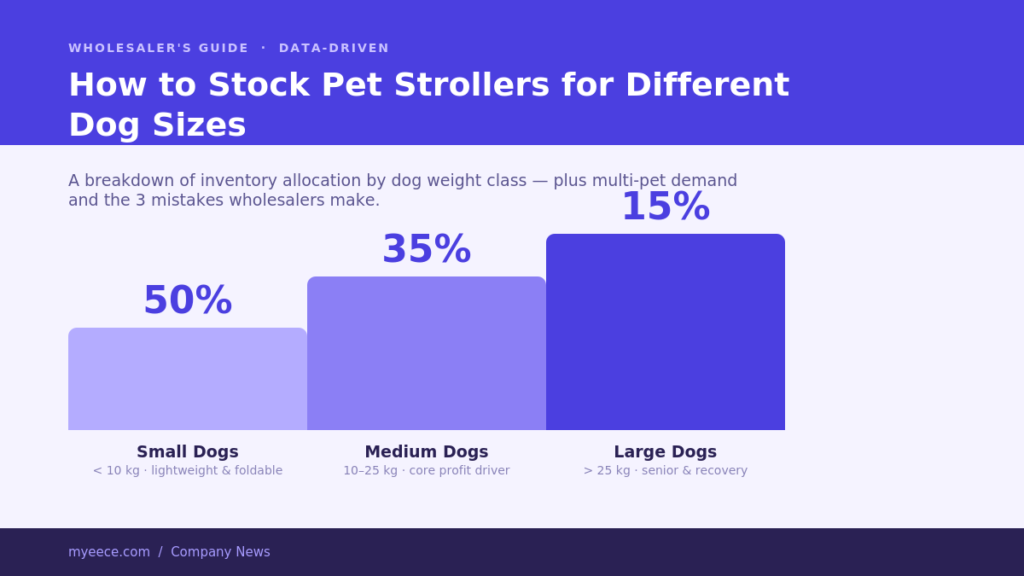
If you're a retailer, Amazon seller, or wholesaler buying pet strollers in bulk, the sizing logic above applies — but your inventory mix determines your cash flow. Based on sales data from 30+ countries, here's a proven split for a first order across three models:
| Size Tier | Suggested Split | Sells Best On | Why |
|---|---|---|---|
| Small (<10 kg) | 50% | Amazon, pet boutiques | Highest search volume, fastest turnover, broadest audience |
| Medium (10–25 kg) | 35% | Pet stores, vet clinics, DTC | Strong margins, health-driven demand, loyal repeat buyers |
| Large (>25 kg) | 15% | Your own website, specialty retail | Highest margin per unit, draws traffic, differentiates your brand |
Suggested inventory split for a first-time pet stroller order across size tiers
Small-dog strollers move fastest and generate cash flow. Medium-dog strollers are the margin backbone. Large-dog strollers set you apart — few competitors carry them, so they pull in customers you'd otherwise miss. Once you have 6 months of sales data, adjust the ratios to your market.
Find the Right Pet Stroller for Every Dog Size
Whether you're buying one stroller for your dog or a hundred for your business, the key is matching the stroller to the dog — not the other way around. A Chihuahua and a Golden Retriever need fundamentally different equipment, and a single "one size fits most" model serves neither well.
At Myeece, our range covers every size from 4.45 kg ultra-lightweights to 80 kg heavy-duty models — all produced under one roof with consistent quality standards. Browse our full catalog of 10 pet stroller models or reach out directly for help matching the right stroller to your dog's size and needs.
Related Reading
- How to Choose a Pet Stroller — Complete Buying Guide
- How to Start a Pet Stroller Business — Complete Guide for Retailers
- Private Label Pet Strollers: Complete OEM/ODM Guide for Wholesale Buyers
- Foldable vs Detachable Pet Strollers: Which Should You Choose?
- Pet Stroller vs Pet Carrier vs Pet Wagon: What's the Difference?