If you want to start a pet stroller business, you are entering a product category with genuine momentum. Global pet industry revenue has surpassed $300 billion, and pet travel products — led by strollers — are one of the fastest-growing segments. A pet stroller business can work as an independent online store, a specialty retail shop, a wholesale distribution operation, or even a private-label brand. This guide walks through every step: choosing your business model, finding reliable suppliers, setting prices that leave room for profit, and marketing to the customers who are actively searching for what you sell.
Step 1: Choose your pet stroller business model
Not all pet stroller businesses look the same. The right model depends on your budget, market, and goals:
| Model | Startup Cost | Best For |
|---|---|---|
| E-commerce retail | $2,000–$10,000 | Selling through your own Shopify/WooCommerce store or marketplaces like Amazon and Mercado Libre. Lowest overhead, easiest to start. |
| Brick-and-mortar retail | $15,000–$50,000 | Physical pet store stocking strollers alongside food, toys, and accessories. Higher trust, but rent and staffing costs apply. |
| Wholesale distribution | $10,000–$30,000 | Buying container loads and reselling to pet shops, vet clinics, and smaller retailers in your region. Higher volume, thinner margins per unit. |
| Private-label brand | $5,000–$25,000 | Creating your own brand with custom logos, colors, and packaging via OEM manufacturing. Highest margin potential, strongest long-term play. |
Most successful businesses start with e-commerce retail, validate which models sell, and then graduate to private-label branding once they know their market. This keeps initial risk low while building toward higher margins.
Step 2: Know which pet stroller types to stock
When you start a pet stroller business, your product mix determines your customer reach. Here are the categories that sell:
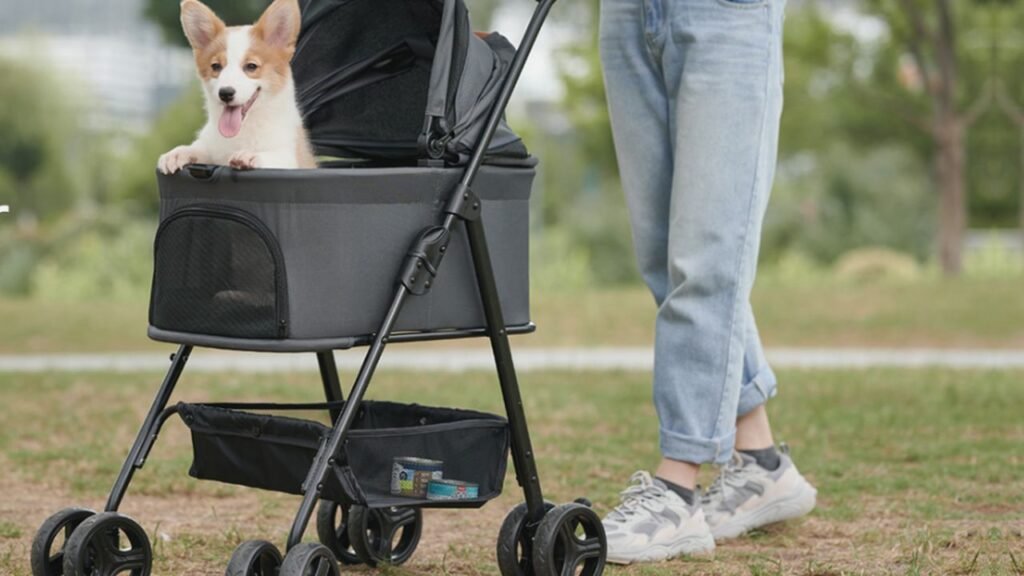
- Standard foldable strollers — The bread-and-butter category. One-hand or two-hand folding, 4 wheels, mesh windows. Appeals to the broadest audience. See our foldable pet stroller wholesale options.
- Heavy-duty strollers for large dogs — Higher price point ($45–$65 FOB), but much less competition. Great margin driver. Our large dog strollers support up to 80 kg.
- Ultra-lightweight strollers for small dogs — Fastest inventory turnover. Price-sensitive buyers, but high volume. Check our small dog stroller wholesale models at 4.45 kg net weight.
- Detachable 2-in-1 strollers — Premium positioning. Combines stroller and carrier in one product. Our 2-in-1 detachable stroller is a top seller for multi-category retailers.
- Pet wagon strollers — Growing niche. Appeals to multi-pet households and outdoor-focused buyers. Our dog wagon stroller is a versatile add-on for any catalog.
Start with 3–4 models covering small, medium, and large dog sizes. This gives you a complete-looking catalog without overcommitting on inventory. Browse the full pet stroller wholesale catalog to see all available models.
Step 3: Source from a reliable manufacturer — not a middleman
The difference between a profitable pet stroller business and a failed one often comes down to who supplies your products. When sourcing from China, you have three options:
- Direct from factory: Best pricing, full OEM/ODM capability, direct quality control. Requires more vetting upfront but pays off long-term. Our factory in Shenzhen produces 5,000+ strollers per month with in-house fabric cutting, sewing, assembly, and wheel pressing.
- Trading companies: Easier to find on Alibaba, but you pay a 10–25% markup. Limited quality control visibility. Best avoided unless you are testing a new category with a tiny order.
- Sourcing agents: A middle-ground option. Agents find and vet factories for you, typically charging 5–10% commission. Useful if you are importing from China for the first time and want someone on the ground.
Regardless of which route you take, always order samples before placing a bulk order. A $50 sample that reveals quality issues saves you a $5,000 order that collects dust in your warehouse.
Step 4: Set prices that leave room for profit
When you start a pet stroller business, pricing correctly from day one determines whether you build a business or a hobby. Here is a realistic retail pricing model:
| Cost Component | Calculation | Example (Standard Foldable) |
|---|---|---|
| FOB unit cost | Factory price ex-works China | $35 |
| Shipping per unit | Sea freight + inland delivery | $5 |
| Customs & duties | Varies by country (0–10%) | $2 |
| Landed cost | Total cost to your warehouse | $42 |
| Wholesale price (B2B) | 1.6–2x landed cost | $67–$84 |
| Retail price (B2C) | 2.5–3.5x landed cost | $105–$147 |
A healthy pet stroller business targets 40–60% gross margin on retail sales and 25–35% on wholesale. If your numbers are below these thresholds, either your sourcing cost is too high or your market positioning is too low.
Step 5: Where and how to sell your pet strollers
- Your own e-commerce store: Shopify or WooCommerce gives you full control over branding, pricing, and customer data. Invest in professional product photos and detailed specifications. A single well-optimized product page with comparison tables and high-resolution images converts better than ten mediocre ones.
- Online marketplaces: Amazon (U.S.), Mercado Libre (Latin America), Allegro (Poland), Trendyol (Turkey) — each region has its dominant marketplace. Marketplace fees run 8–15%, but they bring built-in traffic. Start with one marketplace, master it, then expand.
- Veterinary clinics and pet groomers: B2B wholesale to clinics puts your strollers directly in front of pet owners who need them most — post-surgery pets, senior dogs, and anxious animals. Offer clinics a display unit at cost; they will refer customers to you.
- Pet expos and trade shows: Nothing sells a pet stroller faster than a live demonstration. The one-click fold, the detachable carrier, the smooth ride — these are features customers only fully appreciate in person. Global Pet Expo (U.S.), Interzoo (Germany), and Zoomark (Italy) are the major shows.
Step 6: Marketing that actually works for pet strollers
Pet strollers sell on demonstration and trust. Your marketing should show the product in action:
- Video content converts. A 30-second video showing the one-click fold, the pet inside the cabin, and the stroller rolling smoothly on pavement will outperform any amount of text. Post on TikTok, Instagram Reels, and YouTube Shorts. Tag the pet breed — owners of that breed will find you.
- Target the right keywords. "Pet stroller for large dogs," "foldable dog stroller," "cat stroller for walking" — these are high-intent searches. Build your product page SEO around one specific use case per page.
- Leverage veterinary endorsement. If a local vet recommends your stroller for post-surgery recovery or senior dogs, ask for a testimonial. This is the most powerful trust signal in pet products.
- Offer a guarantee. A 30-day return policy or a 1-year frame warranty signals quality confidence. Buyers new to pet strollers need reassurance — give it to them.
Common mistakes when starting a pet stroller business
- Stocking too many models too early. Start with 3–4 proven SKUs. Every additional model adds inventory cost and management complexity. Add models as sales data tells you what your specific market wants.
- Competing on price alone. The race to the bottom has no winners in pet strollers. Compete on features, build quality, and service. A customer who buys a $50 stroller that lasts 3 years is happier than one who buys a $30 stroller that collapses in 6 months — and they will leave better reviews.
- Ignoring packaging. If your stroller arrives in a damaged box, the customer's trust is damaged before they even see the product. Invest in proper packaging — our cartons are reinforced kraft with internal foam padding designed for international shipping.
- Not having spare parts. Wheels, brakes, and folding mechanisms occasionally need replacement. Stocking a small inventory of spare parts transforms a potential return into a quick customer service fix.
FAQ — Start a Pet Stroller Business
How much does it cost to start a pet stroller business?
An e-commerce pet stroller business can start with $2,000–$10,000 for initial inventory, website, and marketing. A physical retail store costs $15,000–$50,000 including rent deposit, fixtures, and opening inventory. A private-label brand typically starts at $5,000–$25,000 for product development, sampling, and first production run.
Is a pet stroller business profitable?
Yes. Pet strollers typically carry 40–60% gross margin on retail sales (B2C) and 25–35% on wholesale (B2B). A standard foldable stroller with a $42 landed cost retails for $105–$147. Profitability depends on sourcing at factory-direct pricing, optimizing shipping costs, and avoiding middlemen.
Where can I buy pet strollers wholesale to start my business?
You can source directly from manufacturers in China for the best pricing. Myeece is a factory-direct pet stroller manufacturer in Shenzhen offering wholesale, OEM, and ODM services with negotiable MOQ. Browse our pet stroller wholesale catalog or contact us for a customized quote.
What is the best pet stroller to sell first?
Start with a standard one-click foldable 4-wheel stroller — it appeals to the broadest customer base, has proven demand, and is easy to demonstrate. Add an ultra-lightweight model for small-dog owners and a heavy-duty model for large-dog owners as your second and third SKUs.
Can I start a pet stroller business with my own brand?
Yes. OEM/ODM manufacturing lets you customize logos, fabric colors, packaging, and even structural features to create your own brand. Minimum order for full customization is typically 200 units. Contact our team to discuss your private-label requirements.