How to Train Your Dog to Use a Pet Stroller
Learning how to train your dog to use a pet stroller is easier than most owners expect — but only if you respect how dogs actually learn. A pet stroller is a brand-new, enclosed, slightly-moving environment, and no dog instinctively understands it's safe. The key is positive reinforcement and desensitization: introduce the stroller gradually, pair it with things your dog already loves, and never force the process.
This step-by-step guide walks you through the entire training sequence, from your dog's first glance at the stroller to confident rides around the neighborhood. Whether you have a nervous Chihuahua, a stubborn French Bulldog, or a senior dog recovering from surgery, the same principles apply — the only difference is pace.
Why Some Dogs Resist a Pet Stroller
Before you start training, it helps to understand why your dog hesitates. Most resistance comes down to one of three things:
- It's unfamiliar: Dogs are neophobic by nature — they're cautious around anything new. A stroller is big, smells like factory materials, and moves in ways your dog has never experienced.
- It feels unstable: The cabin has a slight flex, and when the wheels roll, your dog's paws feel movement underneath them. For a prey animal's instincts, an unstable surface can feel unsafe.
- Bad first experience: If someone forced your dog into a stroller, zipped it shut, and immediately started rolling, your dog learned "stroller = trapped and scared." Undoing that association takes a bit longer but is very doable.
None of these are permanent. According to the American Kennel Club's guidance on desensitization and counterconditioning, you can change a dog's negative emotional response to any trigger by pairing it with something positive — and keeping the dog "below threshold" the entire time. That's the foundation of everything below.
What You'll Need Before You Start
- The stroller, set up and stationary: Assemble it fully and leave it parked in a room your dog already likes, with the canopy open and the brakes locked.
- High-value treats: Small, soft, smelly treats your dog goes crazy for — not their everyday kibble. Think boiled chicken, cheese, or freeze-dried liver.
- Your dog's favorite blanket or bed: A familiar scent inside the cabin makes it feel like a safe den rather than foreign territory.
- A calm, quiet environment: No kids running around, no other pets, no doorbell. The ASPCA recommends setting up a quiet, low-traffic area for a new or anxious dog to feel safe — the same logic applies to stroller training.
One tip: if your dog already knows "sit," "stay," and "look at me," training will go faster. If not, that's fine — the stroller exercises below will build focus alongside the stroller association.
Step 1: Let Your Dog Investigate (Days 1–2)
Start with the stroller parked and stationary — no movement at all. The goal of this phase is simply: your dog decides the stroller is not a threat.
- Place treats on the floor leading up to the stroller, then inside the cabin floor.
- Let your dog approach at their own pace. If they sniff the wheels, the frame, or peer into the cabin, reward each small step with a treat and praise.
- Do not pick them up and place them inside yet. Let them choose.
- Repeat in short sessions of 5–10 minutes, two or three times a day.
Within a day or two, most dogs will happily trot up to the stroller looking for treats. If your dog is still keeping a wide distance after two days, don't push — just move the treat trail a little closer and keep sessions short. Speed isn't the goal; comfort is.
Step 2: Build a Positive Association (Days 2–4)
Once your dog approaches the stroller without hesitation, it's time to make the inside feel rewarding. This is classic counterconditioning: the stroller becomes a treat dispenser.
- Toss a few high-value treats into the cabin and let your dog jump in to grab them — leave the canopy open and the front opening clear so they can hop in and out freely.
- Feed a few meals inside the stroller, or give a long-lasting chew (like a stuffed Kong) while your dog sits in the cabin.
- Keep the stroller stationary the whole time. The brakes should be locked.
- Place your dog's blanket or bed in the cabin so it starts to smell like home.
The goal is simple: your dog starts to associate the cabin with good things. You'll know you're ready for the next step when your dog hops in on their own, without needing to be lured.
Step 3: Close the Canopy (Days 4–6)
Now your dog is comfortable inside the stroller — but the enclosed feeling of a zipped canopy is a different experience. Introduce it gradually.
- With your dog inside, partially close the canopy (leave the front or top mesh window open). Feed treats through the opening.
- Gradually close more of the canopy over a few sessions, always rewarding calm behavior.
- Once the canopy is fully closed, feed treats through the mesh window so your dog understands the enclosure is temporary and comfortable.
- Keep sessions to 1–2 minutes at first, then build up to 5–10 minutes.
Watch for stress signals — panting, whale eye, lip licking, or trying to scratch out. If you see these, open the canopy back up and go back a step. You're moving too fast, and pushing through will make the problem worse, not better.
Step 4: Introduce Gentle Movement (Days 6–8)
This is the biggest leap for most dogs — the feeling of the floor moving underneath them. Do it in tiny increments.
- With your dog inside and the canopy closed, unlock the brakes and push the stroller one meter. Stop. Reward.
- Do this several times: push a little, stop, reward. Push a little more, stop, reward.
- Keep the movement slow and smooth — no sharp turns, no bumps, no sudden stops.
- Practice indoors or on a smooth, flat surface first. The living room is better than a bumpy sidewalk.
Once your dog stays relaxed during short indoor pushes, graduate to a gentle walk around the house, then the driveway or hallway. Each new surface (carpet → tile → concrete → grass) is a small new challenge, so reintroduce them one at a time.
Step 5: The First Real Walk (Days 8–10+)
By now your dog should be calm inside a moving stroller on a smooth surface. Time for the real thing — but keep the first outing short and positive.
- Keep it under 10 minutes. End on a high note before your dog gets bored or restless.
- Go somewhere calm. A quiet side street is better than a busy park with bikes, kids, and other dogs.
- Bring treats. Reward calm behavior at random intervals throughout the walk.
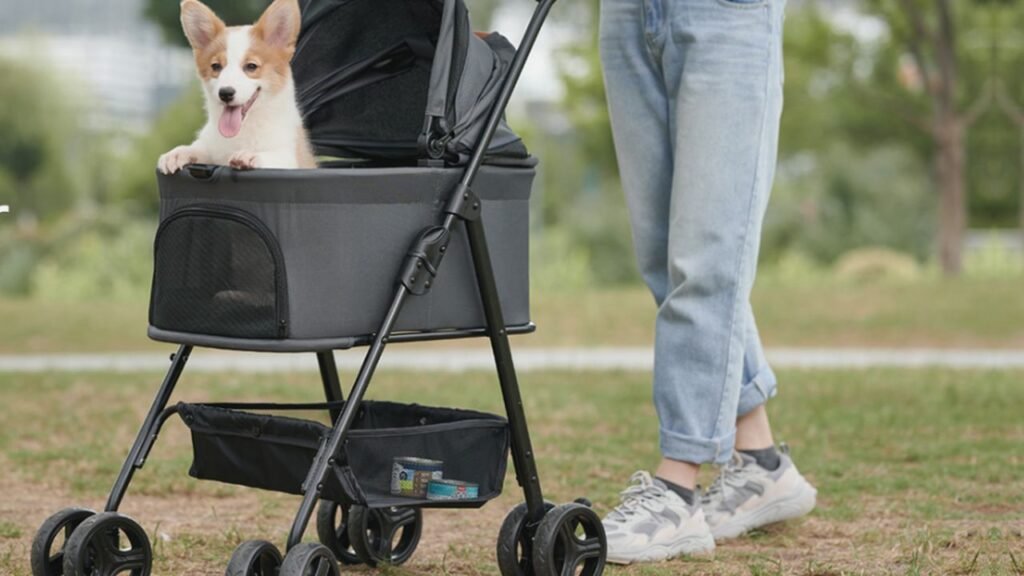
- Let your dog see out. Keep a mesh window open so they can watch the world go by — this is the best part for most dogs.
- End with a treat jackpot. When you get home, give a big reward so the whole experience ends as "fun."
Over the following days, gradually extend the walks. Within a couple of weeks, most dogs will jump into the stroller eagerly — some even come to prefer it for hot days or long outings. If your dog is a senior or recovering from an injury, check out our guide on how to choose a pet stroller to make sure the cabin size, entry height, and padding fit their specific needs.
Special Cases: Anxious Dogs, Seniors, and Multiple Pets
Anxious or Fearful Dogs
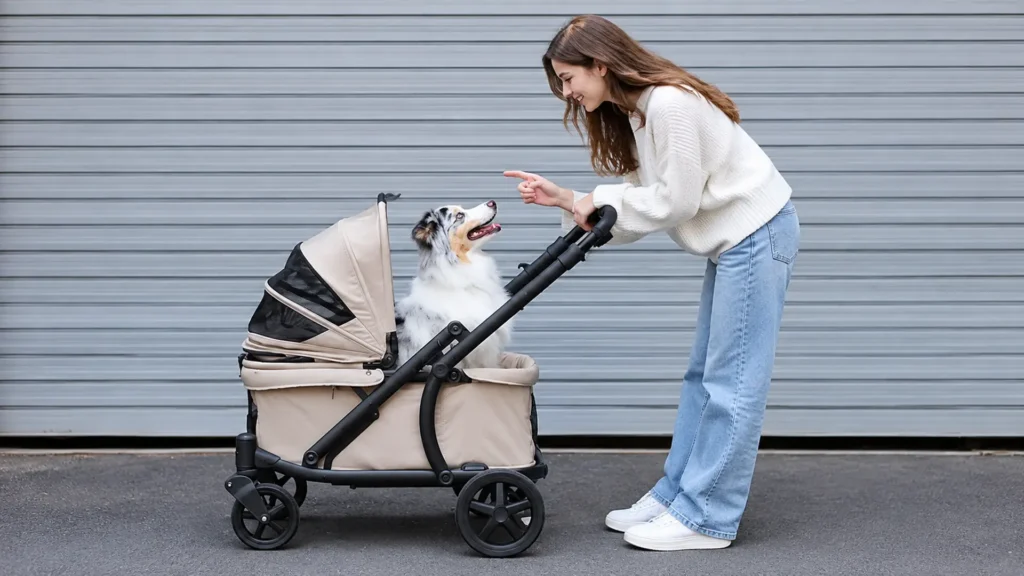
Go slower. Spend a full week on each step instead of a few days. Never force the canopy closed, and never push the stroller if your dog is visibly stressed. A wagon-style stroller with a wide, low, open cabin often feels less confining than an enclosed traditional stroller, which can help fearful dogs adjust faster.
Senior Dogs or Dogs with Mobility Issues
For seniors, the priority is safe entry and exit, not speed. Choose a stroller with a low rear entry or a fold-down ramp, so your dog never has to step high or be lifted awkwardly. Keep sessions short and gentle, and let your dog rest in the cabin as often as they like. A heavy-duty stroller with a reinforced frame gives large seniors a stable, non-flexing platform that feels secure underfoot.
Multiple Dogs
Train each dog separately first. Two dogs learning at once means two different comfort levels, and one nervous dog can stress out the other. Once both are comfortable solo, introduce them together in a two-pet wagon or wide stroller with separate safety tethers.
5 Common Mistakes That Undo Your Training
Mistake 1: Forcing Your Dog In
Physically placing a struggling dog into the stroller and zipping it shut is the fastest way to create a lasting negative association. It might "work" in the moment, but you'll pay for it later with a dog that panics at the sight of the stroller. Always let your dog enter voluntarily.
Mistake 2: Rushing the Movement Phase
The jump from "stationary stroller" to "moving stroller" is where most training fails. If you roll the stroller while your dog is still nervous inside, you reinforce the fear. Master each step completely before moving to the next — even if it feels slow.
Mistake 3: Using the Stroller as Punishment
Never use the stroller as a "time out" spot. Your dog should never associate the cabin with being banished or scolded. It should always be a positive, safe space.
Mistake 4: Skipping the Safety Tether
Once training is done and you're out on walks, always clip your dog's harness to the interior safety tether. Even a well-trained dog can jump at a sudden squirrel, and the tether prevents a fall from a moving stroller.
Mistake 5: Training on an Empty Stomach (Or a Full One)
Train when your dog is mildly hungry, so treats are extra motivating — but not starving, which creates stress. Avoid training right after a big meal; a full stomach makes a dog sluggish and less responsive.
Frequently Asked Questions
How long does it take to train a dog to use a pet stroller?
For most dogs, 7 to 14 days of short daily sessions is enough to go from first introduction to confident rides. Nervous dogs, seniors, or dogs with a prior bad experience may take 3–4 weeks. The pace depends entirely on your dog — let comfort, not a calendar, be your guide.
Why does my dog refuse to get in the pet stroller?
Usually it's one of three reasons: the stroller is unfamiliar, it feels unstable when moving, or the dog had a negative first experience (often being forced inside). All three can be fixed with slow desensitization and positive reinforcement — the exact steps in this guide.
Can I train an older dog to use a pet stroller?
Yes — and it's often easier than training a puppy. Older dogs are calmer and have better focus. The main consideration is physical comfort: choose a stroller with a low entry point and a stable, non-flexing frame so an older dog feels secure getting in and out.
Should I keep the canopy closed while training?
Not at first. Start with the canopy fully open so your dog feels they can leave freely. Close it gradually over several sessions, and always keep at least one mesh window open so your dog can see out — this reduces the trapped feeling that causes anxiety.
What if my dog tries to jump out of a moving stroller?
Always use the interior safety tether clipped to your dog's harness, never the collar. If your dog still tries to jump, they're likely not ready for movement yet — go back to stationary training and slower, shorter pushes. Jumping is a sign you moved too fast, not a sign of stubbornness.
Choosing the Right Stroller Makes Training Easier
The right equipment removes half the training challenge. Look for a stroller that feels stable (a rigid frame with no flex), has a low or accessible entry, and offers good ventilation so your dog never feels hot or trapped. A dog that's physically comfortable inside a stroller will learn to love it much faster.
Browse our full range of pet strollers to find the right fit — from the ultra-lightweight 4.45 kg model for small dogs to the heavy-duty 80 kg model for large breeds, plus foldable models and two-pet wagons. Every model is produced in our in-house factory with stable frames, breathable mesh, and secure safety tethers.
Questions about which stroller fits your dog best? Contact us →
Related Reading
- How to Choose a Pet Stroller — Complete Buying Guide
- How to Start a Pet Stroller Business — Complete Guide for Retailers
- Private Label Pet Strollers: Complete OEM/ODM Guide for Wholesale Buyers
- Foldable vs Detachable Pet Strollers: Which Should You Choose?
- Pet Stroller vs Pet Carrier vs Pet Wagon: What's the Difference?